
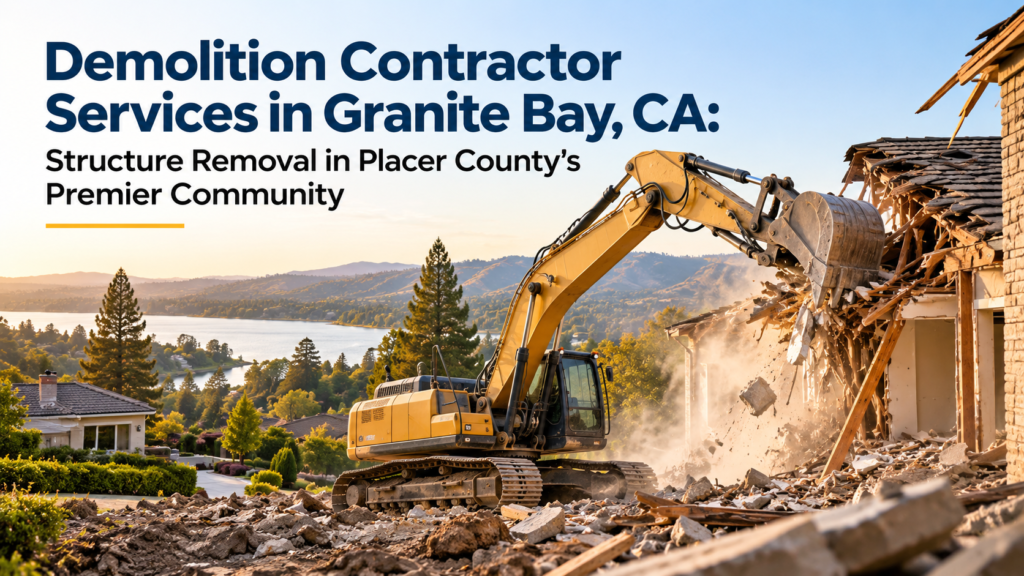
Granite Bay is one of the Sacramento metro area’s most affluent communities an unincorporated Placer County area along the shores of Folsom Lake, characterized by large-lot residential properties, executive homes, equestrian estates, and the high-end residential development that has made it a destination address for the Sacramento region’s professional and business community. Demolition Contractor Granite Bay differs in character from the post-war suburban teardowns common in Sacramento County’s older communities: here, the projects more often involve removing older custom homes to build new larger residences, demolishing outbuildings and ancillary structures on large properties, or clearing structures for agricultural and equestrian facility upgrades. The regulatory context also shifts to Placer County rather than Sacramento County.
Placer County’s Regulatory Framework for Demolition
Granite Bay falls within unincorporated Placer County, which means demolition permits are issued by the Placer County Department of Community Development rather than Sacramento County. Placer County administers California’s building codes through its own planning and building department, and its permit process has some differences in form and procedure from Sacramento County’s, though the underlying regulatory standards California Building Code, Title 24, and related codes are the same statewide.
California’s pre-demolition asbestos survey requirements apply in Placer County as throughout the state. The local air quality management district for the Granite Bay area is the Placer County Air Pollution Control District (PCAPCD), which administers asbestos notification requirements for demolition projects in Placer County. PCAPCD’s rules mirror California’s statewide framework: surveys for pre-1979 structures, advance notification before demolition involving regulated material, and Cal/OSHA-registered abatement contractors for any identified regulated asbestos.
The California Environmental Quality Act (CEQA) review may apply to some demolition projects in Granite Bay that involve significant trees, biological resources, or properties in sensitive environmental areas near Folsom Lake. Placer County serves as the lead agency for CEQA review of projects in unincorporated areas. Property owners planning demolition near the Folsom Lake State Recreation Area shoreline or in areas with oak woodland resources should verify whether CEQA review applies to their project.
Granite Bay’s Large-Lot Properties and Demolition Logistics
Granite Bay’s residential properties tend to be larger than typical Sacramento County suburban lots one-acre, two-acre, and larger parcels are common throughout the community, with some equestrian properties extending to five, ten, or more acres. This large-lot character creates a different demolition logistics context than the densely developed post-war suburbs: more room for equipment staging, more flexibility in haul truck access, and less concern about impacts on immediately adjacent residential neighbors.
However, the large lots also mean longer haul distances from structures to public roads, and the rural character of some Granite Bay roads narrow lanes, limited turnout opportunities, gates and fencing typical of equestrian properties requires attention to equipment and truck access planning. Larger custom homes being demolished may require more powerful demolition equipment than a standard suburban teardown, and the volume of debris from a larger home requires more haul trips.
Equestrian facilities and agricultural outbuildings on Granite Bay properties present specific demolition considerations. Large steel-frame equipment barns, wooden horse barns, and ancillary structures are common on rural-residential properties in this area. Steel-frame structures require specialized cutting and handling; wooden barns in poor condition must be approached carefully given the potential for structural collapse during demolition of deteriorated elements.
Environmental Sensitivity Near Folsom Lake
Granite Bay’s proximity to Folsom Lake State Recreation Area and the American River watershed creates environmental sensitivity that shapes demolition requirements for properties near the lake and its tributaries. Folsom Lake is a critical water supply reservoir for the Sacramento region maintaining its water quality is a high-priority regulatory objective for Placer County, the Sacramento Regional County Sanitation District, and the State Water Resources Control Board.
Construction stormwater from demolition and site clearing on Granite Bay properties must be managed to prevent sediment-laden runoff from reaching the lake or its tributary streams. The Placer County Stormwater Management Program and the Central Valley Regional Water Quality Control Board (which includes Placer County in its jurisdiction) enforce construction stormwater requirements. The Construction General Permit applies to disturbances above one acre, and smaller disturbances must still implement appropriate BMPs under Placer County’s local requirements.
Oak woodland resources valley oaks, blue oaks, and other native oaks are protected under Placer County’s oak tree preservation ordinance and potentially under CEQA. Demolition on wooded Granite Bay properties must identify and protect significant oaks. Tree protection plans specifying protection zones, fencing requirements, and limitations on grading within root zones are standard for projects in areas with significant oak resources.
Granite Bay’s Housing Stock and Structural Conditions
Granite Bay’s residential development spans several eras: older homes from the 1960s and 1970s when the community was first developed as an upscale retreat, and a large wave of custom home construction from the 1980s through the 2000s when Granite Bay emerged as a premier executive address. The older homes 1960s and 1970s custom construction are in the asbestos survey age range and may have the period’s characteristic materials: asbestos-containing ceiling texture, floor tiles, pipe insulation, and roofing products.
Custom homes in Granite Bay tend to be larger and more complex structurally than standard tract construction. More complex roof forms, larger spans, custom foundation designs, and higher-grade materials all affect demolition planning and execution. Larger concrete foundations from high-end custom homes require more time and equipment to remove than standard slab foundations. Complex framing configurations require more careful demolition sequencing to manage structural stability throughout the process.
Frequently Asked Questions: Demolition Contractor in Granite Bay, CA
Is Granite Bay part of Sacramento County or Placer County?
Granite Bay is an unincorporated community in Placer County not Sacramento County. Building and demolition permits are issued by the Placer County Department of Community Development. Environmental compliance for asbestos notification is administered by the Placer County Air Pollution Control District (PCAPCD) rather than SMAQMD. This distinction matters for permit applications and knowing which county offices to contact for regulatory questions.
How does Folsom Lake proximity affect demolition projects in Granite Bay?
Folsom Lake is a critical water supply reservoir, and its watershed is subject to strong stormwater protection requirements. Demolition and site clearing near Folsom Lake or its tributary streams must implement effective erosion and sediment controls to prevent runoff from reaching the lake. The Central Valley Regional Water Quality Control Board and Placer County’s stormwater program enforce these requirements. Projects near the lake shoreline may also trigger CEQA review for biological and water quality impacts.
What tree protections apply to demolition on wooded Granite Bay properties?
Placer County has an oak tree preservation ordinance that protects significant native oaks. Demolition on properties with significant oaks must identify protected trees, establish protection zones around them, and implement measures to prevent root zone damage from demolition equipment and site disturbance. CEQA review may also require biological resource assessment for projects in areas with oak woodland. Property owners should identify tree protection requirements early in demolition planning to avoid permit delays.
What is the asbestos survey requirement for Granite Bay’s older custom homes?
California requires pre-demolition asbestos surveys by a California-certified inspector for structures built before 1979. Granite Bay’s older custom homes from the 1960s and 1970s fall within this requirement. Given the high-end nature of custom construction from this era, these homes may contain asbestos in a wider range of products than standard tract construction premium ceiling finishes, imported tiles, custom HVAC systems with asbestos-containing insulation. PCAPCD must be notified before demolition of structures where regulated asbestos is identified.
